Intellectual property and commercial courts
Can a Civil Judge Notified as a Commercial Court Hear a Trademark Infringement Suit?
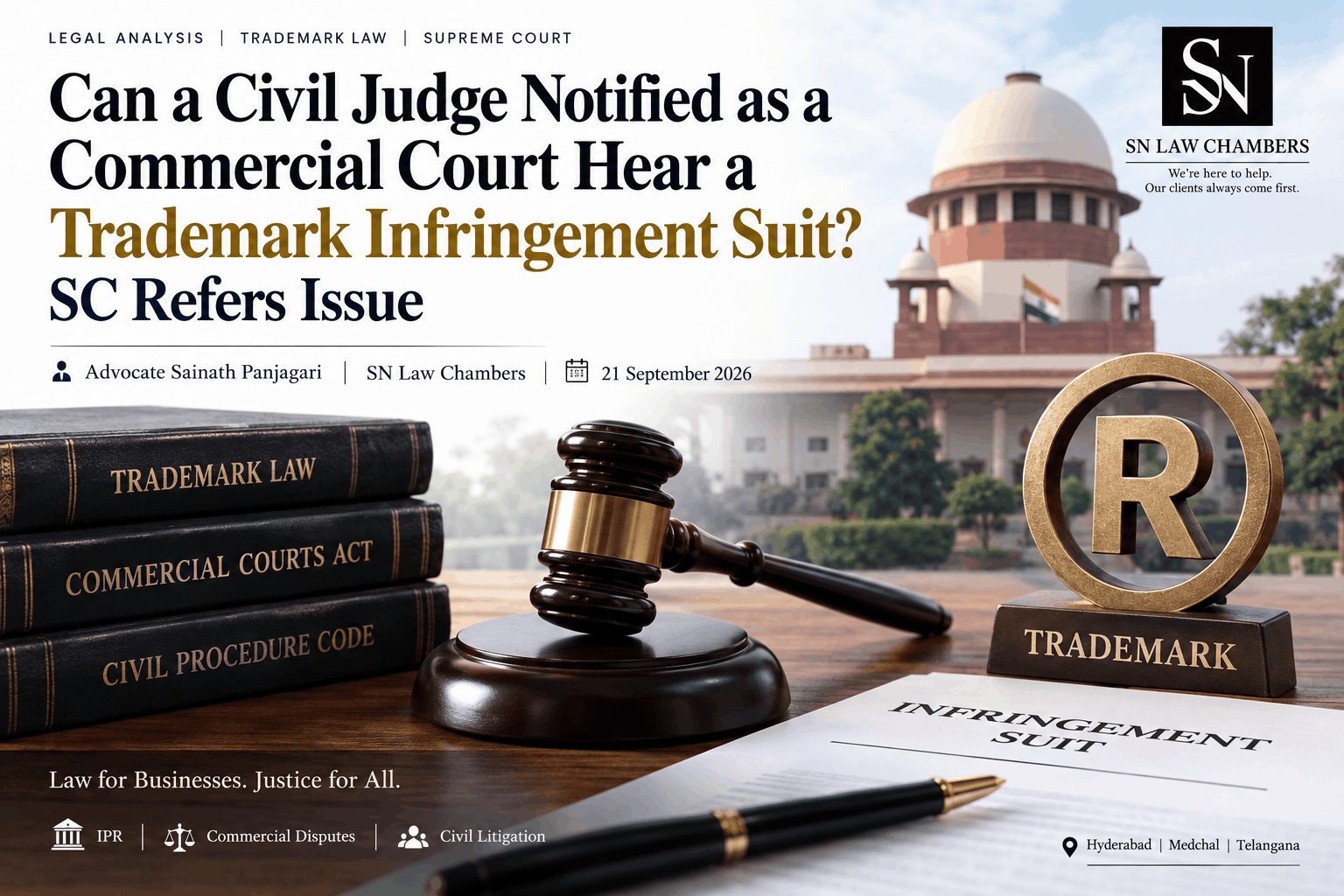
The Supreme Court has not answered the question. On 21 September 2026 a two-judge Bench referred it to a Larger Bench: whether a Civil Judge (Senior Division), notified as a Commercial Court under the Commercial Courts Act, 2015, can try a trademark infringement or passing-off suit even though Section 134 of the Trade Marks Act, 1999 bars such suits in any court inferior to a District Court. Until that Bench speaks, the law is not uniform across States. In Telangana the commercial courts already sit at District Judge level, so the exact Jharkhand problem does not arise in the same form.
Key Takeaways
- Section 134 still says a trademark infringement, registered-mark rights, or passing-off suit cannot be instituted in a court inferior to a District Court.
- The Commercial Courts Act treats intellectual-property disputes, including registered and unregistered trademarks, as commercial disputes of specified value (not less than ₹3 lakh unless a higher figure is notified).
- I.S.D.S. Private Limited v. Khemka Food Products does not decide the clash. It stays Commercial Suit No. 11 of 2023 at Jamshedpur and sends the conflict between two earlier Supreme Court lines to the Chief Justice for a Larger Bench.
- Telangana has notified commercial courts in the cadre of District Judge at Hyderabad and L.B. Nagar. A Civil Judge (Senior Division) is not the notified commercial court for the State.
- Do not treat a High Court notification as a licence to ignore Section 134, specified value, Section 12A mediation, or territorial jurisdiction under Section 134(2).
Case snapshot
| Item | Particulars |
|---|---|
| Cause title | I.S.D.S. Private Limited & Anr. v. M/s Khemka Food Products Pvt. Ltd. & Anr. |
| Case number | Civil Appeal of 2026 arising from Special Leave Petition (C) No. 6793 of 2026 |
| Court and bench | Supreme Court of India — Justice J.B. Pardiwala and Justice K. Vinod Chandran |
| Date of order | 21 September 2026, New Delhi |
| Nature of order | Non-Reportable. Leave granted. Question referred to a Larger Bench. Not a final ruling on the trademark or on jurisdiction. |
| Citation (report) | 2026 LiveLaw (SC) 968 |
| Pending trial suit | Commercial Suit No. 11 of 2023 before the Civil Judge (Senior Division)–I, Jamshedpur — stayed |
| High Court history | Jharkhand High Court, Commercial Appeal No. 14 of 2024, had restored the suit before the notified Civil Judge (Senior Division) Commercial Court |
| Question referred | Whether Section 134 of the Trade Marks Act is rendered otiose when a State notifies a Civil Judge (Senior Division) as a Commercial Court |
What Section 134 of the Trade Marks Act actually requires
Section 134(1) is a forum floor, not a suggestion. No suit (a) for infringement of a registered trade mark, (b) relating to any right in a registered trade mark, or (c) for passing off arising from use of a mark identical with or deceptively similar to the plaintiff’s mark, registered or unregistered, shall be instituted in any court inferior to a District Court having jurisdiction to try the suit.
Section 134(2) then widens territorial choice for clauses (a) and (b). Notwithstanding the Code of Civil Procedure, 1908, a “District Court having jurisdiction” includes the District Court where the person instituting the suit actually and voluntarily resides, carries on business, or personally works for gain. The Explanation includes the registered proprietor and the registered user. Passing-off under clause (c) does not get that extra plaintiff-centric forum; it still cannot go below District Court, but territorial jurisdiction follows the ordinary Code rules unless another statute applies.
The legislative object is straightforward. Trademark and passing-off trials raise comparison of marks, reputation, confusion and often interlocutory injunctions under Section 135. Parliament put that work at District Court level and above.
What the Commercial Courts Act does to intellectual-property suits
Section 2(1)(c)(xvii) of the Commercial Courts Act, 2015 defines a commercial dispute to include disputes arising out of intellectual property rights relating to registered and unregistered trademarks, copyright, patent, design, domain names, geographical indications and semiconductor integrated circuits.
Two further filters then apply:
- Specified value, under Section 2(1)(i) read with Section 12, is not less than three lakh rupees unless a higher value is notified. The 2018 amendment brought that floor down from one crore rupees with effect from 3 May 2018. For an intangible right, Section 12(1)(d) takes the market value of the right as estimated by the plaintiff.
- Section 3 lets the State Government, after consultation with the High Court, constitute Commercial Courts at the District level. Section 21 gives the 2015 Act overriding effect where there is inconsistency with any other law for the time being in force.
That is the collision. One statute says “not inferior to a District Court”. The other lets a High Court notification place commercial work, including trademarks, before whatever court the State constitutes at “District level” — and some States have used that phrase to notify the Civil Judge (Senior Division).
How the Jamshedpur trademark suit reached the Supreme Court
The commercial dispute behind the reference is a mark used on wheat-flour products. Khemka Food Products instituted a suit for infringement and passing off as Commercial Suit No. 11 of 2023 before the Civil Judge (Senior Division)–I-cum-Commercial Court at Jamshedpur, after the pre-institution mediation step under Section 12A. The trial court later returned the plaint on the footing that Section 134 confined such suits to a District Court. The Jharkhand High Court reversed that return and held that a Civil Judge (Senior Division), once designated as a Commercial Court, is not a court “inferior to a District Court” for this purpose.
I.S.D.S. Private Limited and its director challenged that view. The Supreme Court granted leave on 21 September 2026. It did not decide who owns the mark. It framed the statutory question and stayed the Jamshedpur suit.
The two Supreme Court lines the Bench could not reconcile
Kandla Export Corporation v. OCI Corporation (2018) 14 SCC 715
Kandla Export asked whether an appeal that Section 50 of the Arbitration and Conciliation Act, 1996 does not allow can still be filed under Section 13(1) of the Commercial Courts Act. The Court treated the Arbitration Act as a self-contained code and the Commercial Courts Act as the more general statute on commercial appeals. The special appellate scheme of the Arbitration Act prevailed. Counsel for the appellants in I.S.D.S. invited the same logic: the Trade Marks Act is special on forum; a later general commercial-court statute should not wipe out Section 134.
Jaycee Housing Pvt. Ltd. v. Registrar (General), Orissa High Court (2023) 1 SCC 549
Jaycee Housing upheld an Odisha notification that constituted the Civil Judge (Senior Division) as a Commercial Court and allowed that court to hear applications under Sections 9, 14 and 34 of the Arbitration Act. The Court relied on Sections 3, 10, 15 and 21 of the 2015 Act, the later-in-time rule, and the object of speedy disposal of commercial disputes, including arbitration. On that view, a special forum clause in an earlier statute yields to the commercial-court scheme once the dispute is a commercial dispute of specified value.
The 21 September 2026 Bench recorded the tension in these words:
“We have to notice that Jaycee Hosing Private Limited and Ors. had categorically held that Section 9, 14 and 34 has to concede insofar as jurisdiction is concerned, to the Commercial Courts Act, finding it to be a special enactment as is the case with the Arbitration and Conciliation Act. Kandla Export Corporation and Anr. on the other hand found that the Arbitration Act is a code unto itself and vis-a-vis the Commercial Courts Act, the former is a special legislation, and the latter is a general legislation.”
The same order also recalled Fun N. Fud v. GLK Associates, 2019 SCC OnLine Guj 4236, a Gujarat High Court decision authored by Justice Pardiwala as he then was, holding that an application under Section 9 of the Arbitration Act still lies before the District Court having principal civil jurisdiction even if the Civil Judge (Senior Division) is notified as a Commercial Court.
What the Supreme Court actually held on 21 September 2026
The Bench did not choose between Kandla Export and Jaycee Housing. It explained why the choice cannot be left to State-wise notifications.
Paragraph 10 of the order treats commercial disputes in Section 2(1)(c) as the genus and trademarks as one species under clause (xvii). It notes that Section 3 permits High Courts to notify Commercial Courts at District level, which includes District Courts, and that Section 21 overrides only when another law is inconsistent. Conferring jurisdiction on District Judges as Commercial Courts is not, in the Bench’s tentative view, inconsistent with Section 134. The problem arises only when the notification constitutes Civil Judges as Commercial Courts.
Paragraph 11 flags a valuation anomaly in Jharkhand: a trademark suit valued below ₹3 lakh would still have to go to the District Court under Section 134, while a suit between ₹3 lakh and ₹1 crore would go to the Civil Judge (Senior Division) Commercial Court. Paragraph 12 notes that Kerala later designated District Courts and Additional District Courts as Commercial Courts at District Judge level for disputes under the Arbitration Act, the Copyright Act, the Trade Marks Act, the Patents Act and other statutes that vest first-instance jurisdiction in the principal civil court of the district.
“We are of the opinion that the matter has to be referred to the Larger Bench for resolving the conflict and also settling the law to be uniform throughout the States and the jurisdiction not to be left to the different notifications issued in the various States. In our humble view the legislative imprimatur cannot be diluted by the notifications issued by the High Courts. The matter shall be placed before the Hon’ble the Chief Justice of India for appropriate orders.”
The operative directions are only two: reference to the Chief Justice for constitution of a Larger Bench, and stay of Commercial Suit No. 11 of 2023 before the Civil Judge (Senior Division)–I, Jamshedpur.
What this order does not decide
- It does not hold that every Civil Judge (Senior Division) Commercial Court in India lacks trademark jurisdiction.
- It does not hold that Section 134 has been impliedly repealed by Section 21 of the Commercial Courts Act.
- It does not decide infringement, passing off, or the mark “Grihasti Bhog”.
- It does not stay trademark suits in Telangana, or any suit other than Commercial Suit No. 11 of 2023 at Jamshedpur.
- It does not alter specified value, Section 12A pre-institution mediation, or limitation.
Where should a trademark infringement suit be filed in Telangana?
Telangana did not copy the Jharkhand model of notifying the Civil Judge (Senior Division) as the Commercial Court. By G.O.Ms.No. 52, Law Department, dated 18 December 2020, read with G.O.Ms.No. 4, Law Department, dated 18 January 2021, the State notified two special courts in the cadre of District Judge: one at Hyderabad and one at L.B. Nagar in Ranga Reddy District. The Hyderabad court covers the revenue limits of Hyderabad. The Ranga Reddy court covers the rest of Telangana.
For a Hyderabad or Medchal brand owner, the working rule until the Larger Bench speaks is therefore:
- If the dispute is a trademark or passing-off claim and the specified value is ₹3 lakh or more, file it as a commercial suit before the notified District Judge Commercial Court that has territorial competence — not before a Civil Judge (Senior Division) or Junior Civil Judge.
- If the claim is below specified value, Section 134 still points to a District Court. Do not assume a small-cause or junior civil court can take it because the mark is “commercial”.
- Use Section 134(2) only for registered-mark claims under clauses (a) and (b), and only where the plaintiff actually resides or carries on business in that district. Do not manufacture a Hyderabad office on paper to attract City Civil Court if the business is elsewhere.
- Complete Section 12A pre-institution mediation unless the plaint seeks urgent interim relief that the court accepts as genuine. A bare injunction prayer is not always enough to skip mediation.
The Larger Bench may still recast this map for the whole country. Until then, Telangana litigants should file at District Judge level and keep a copy of the State notification with the plaint.
Procedure, documents and limitation
Before filing
- Confirm whether the mark is registered, pending, or used only in passing off. Section 134(2) extra forum is for registered-mark claims.
- Value the intangible right honestly under Section 12 of the Commercial Courts Act. An inflated figure to reach specified value, or a suppressed figure to avoid the commercial track, is a preliminary objection waiting to be taken.
- Collect the registration certificate, legal-user certificate if any, invoices, packaging, advertisement spend, cease-and-desist correspondence and a side-by-side comparison of the two marks.
- Decide whether you need an ex parte ad-interim injunction under Section 135(2). If you do, plead urgency with dates. If you do not, finish Section 12A mediation first.
Limitation
There is no separate trademark article that practitioners can quote as mechanically as Article 88 of the Limitation Act, 1963 does for copyright compensation. Courts ordinarily treat a claim for infringement or passing off as governed by a three-year period from when the right to sue accrues, and they also recognise continuing use as a continuing wrong for injunction. Do not assume that long, open use by the defendant is harmless. Date of knowledge, date of first infringing use, and whether the wrong is continuing must be pleaded. A stale claim for damages is weaker than a live claim for injunction.
Appeals
That is the practical sting the appellants stressed in I.S.D.S. If the first court is a Civil Judge (Senior Division) Commercial Court, the first appeal under the Commercial Courts Act may stop at the District Court. The High Court’s role then shrinks to revision or Article 227, which does not re-appreciate evidence. In Telangana, because the commercial court is already at District Judge level, the commercial appeal goes to the Commercial Appellate Division of the High Court. That difference in the appeal ladder is one reason the Supreme Court wants one national rule.
Common mistakes this reference exposes
- Filing a trademark or passing-off suit before a court below District Judge cadre because “it is a commercial dispute”.
- Treating the 21 September 2026 order as a stay of every commercial trademark suit in India.
- Ignoring specified value and landing in the wrong track — ordinary District Court versus Commercial Court.
- Using Section 134(2) for a pure passing-off claim as if the plaintiff-centric forum applied to clause (c).
- Skipping Section 12A mediation without pleading a real claim to urgent interim relief.
- Assuming a High Court notification can enlarge a Civil Judge’s status for all special statutes that say “District Court”.
Related reading on SN Law Chambers
Frequently Asked Questions
Can a Civil Judge (Senior Division) hear a trademark infringement suit?
Not as a settled all-India rule. Section 134 still names the District Court as the floor. Some States have notified the Civil Judge (Senior Division) as a Commercial Court. The Supreme Court has referred that clash to a Larger Bench and has stayed the Jamshedpur suit that raised it.
Does the 21 September 2026 order stay my Hyderabad trademark suit?
No. Only Commercial Suit No. 11 of 2023 before the Civil Judge (Senior Division)–I, Jamshedpur, is stayed. Telangana commercial courts sit at District Judge level.
Is a trademark dispute always a commercial dispute?
It falls under Section 2(1)(c)(xvii) of the Commercial Courts Act. It becomes a commercial suit of specified value only if the subject-matter, valued under Section 12, is at least ₹3 lakh or any higher notified figure.
Where do I file in Hyderabad if my brand is used from Medchal?
Look first at where the plaintiff resides or carries on business (for registered-mark claims under Section 134(2)), where the defendant resides or works, and where the cause of action arose. Then file in the notified District Judge Commercial Court that covers that territory — Hyderabad or L.B. Nagar — if specified value is met.
Do I still need pre-institution mediation?
Yes, for a commercial suit of specified value, unless the court accepts that the plaint seeks urgent interim relief. The I.S.D.S. reference does not waive Section 12A.
Has Section 134 been overridden by Section 21 of the Commercial Courts Act?
That is the question sent to the Larger Bench. The two-judge order records a tentative view that notifying District Judges as Commercial Courts is consistent with Section 134, and that the difficulty arises when Civil Judges are notified. Treat that as a reason for the reference, not as the last word.
What happens to limitation while the Larger Bench is pending?
Limitation for your own claim keeps running. The reference is not a blanket stay and not an extension of time.
Is this a reported binding precedent on merits?
The order is marked Non-Reportable. It is binding as an order of the Supreme Court on the reference and the stay. It is not a conclusive declaration that one of the two earlier decisions is wrong.
How SN Law Chambers can help
SN Law Chambers assists clients in Hyderabad and Medchal who need to choose the correct court for a trademark, passing-off or other commercial claim, draft the plaint or written statement, apply for or resist an interim injunction, and raise or answer a jurisdiction objection. A consultation is for the papers in your matter — registration, user, valuation and the live notification — not for a prediction of what the Larger Bench will hold.
Sources / Legal Authorities
- I.S.D.S. Private Limited & Anr. v. M/s Khemka Food Products Pvt. Ltd. & Anr., Civil Appeal arising from SLP (C) No. 6793 of 2026, Supreme Court, 21 September 2026 (Non-Reportable); reported as 2026 LiveLaw (SC) 968.
- Order PDF (LiveLaw upload): Civil Appeal @ SLP (C) No. 6793 of 2026.
- Trade Marks Act, 1999, Sections 134 and 135.
- Commercial Courts Act, 2015, Sections 2(1)(c)(xvii), 2(1)(i), 3, 12, 12A, 13, 15 and 21.
- Kandla Export Corporation v. OCI Corporation, (2018) 14 SCC 715.
- Jaycee Housing Pvt. Ltd. v. Registrar (General), Orissa High Court, (2023) 1 SCC 549; 2022 LiveLaw (SC) 860.
- Fun N. Fud v. GLK Associates, 2019 SCC OnLine Guj 4236.
- G.O.Ms.No. 52, Law (LA, LA&J-Home-Courts.A2) Department, Government of Telangana, dated 18 December 2020; G.O.Ms.No. 4, dated 18 January 2021 (commercial courts at District Judge cadre, Hyderabad and L.B. Nagar).
- LiveLaw report, 21 September 2026, “Can Civil Judge Notified As Commercial Court Hear Trademark Infringement Suits? Supreme Court Refers To Larger Bench”.
Conclusion
Section 134 still starts at the District Court. The Commercial Courts Act still pulls intellectual-property disputes of specified value onto the commercial track. I.S.D.S. v. Khemka Food Products holds only that those two commands cannot be left to whatever notification a High Court issues, and that a Larger Bench must settle the Civil Judge question for every State. In Telangana, file at the notified District Judge Commercial Court, value the claim with care, and do not treat a news report of this reference as a stay of your own suit.
Consult SN Law Chambers
For a trademark, passing-off or commercial-suit jurisdiction question arising in Hyderabad or Medchal, contact SN Law Chambers.
Plot No. 33, Survey No. 874, Gandimaisamma Road, Medchal Check Post, Medchal, Telangana 501401
contact@snlawchambers.in | +91 88969 66663
Consultations by appointment, Monday to Saturday.
Website: https://snlawchambers.in/
Legal Disclaimer
This article provides general legal information. The order discussed refers a question of law and stays one Jamshedpur suit. It is not a final declaration that a Civil Judge (Senior Division) Commercial Court has, or lacks, trademark jurisdiction in every State. Notifications and rosters change. Obtain case-specific advice before filing or objecting to jurisdiction.